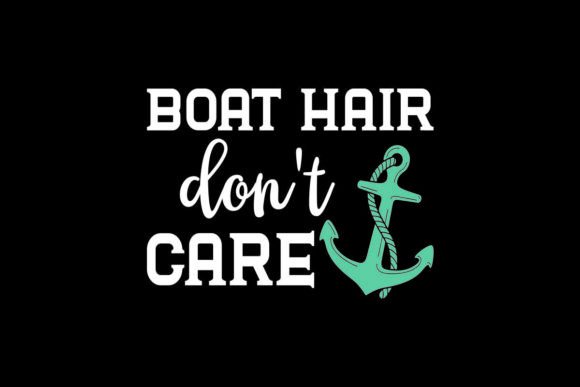
Boat Hair Don't Care: A Designer's Review for Real Projects
As someone who spends more time at the hoop than on dry land, I know that a good design isn't just about the image; it's about how that image translates into thread. When I first pulled up the Boat Hair Don t Care file, I wasn't looking for another generic clipart piece to sit in a folder. I was looking for a graphic that could carry a product line for a coastal boutique client. This review breaks down how this specific illustration holds up when you move from the screen to the sewing machine, focusing on practical application for small business owners and serious hobbyists.
First Impressions: Mood and Visual Personality
The immediate vibe of Boat Hair Don t Care is relaxed, salty, and unapologetically fun. It captures that specific moment of stepping off a vessel where grooming takes a backseat to the wind and water. As an Illustration, the lines appear clean and deliberate, which is crucial for embroidery. In my line of work, messy vectors lead to messy stitches. The layout suggests a balance between the textual element and the graphical representation of the boat or waves, creating a composition that feels intentional rather than cluttered.
What stands out initially is the potential for personality. This isn't a stiff, corporate logo; it's a lifestyle statement. For an Etsy seller or a craft business owner targeting the boating community, this design assets offers a ready-made identity. The visual weight seems distributed well, meaning it shouldn't pull or distort heavily on lighter fabrics, provided the digitizing matches the quality of the source Graphics.
Real-World Application: From File to Finished Product
To truly test the viability of this machine embroidery design, I imagined a specific scenario: a custom order for a local marina gift shop. They needed a series of tote bag designs and sweatshirt embroidery options for the upcoming summer season. The Boat Hair Don t Care concept fit perfectly here.
For the tote bags, I envisioned using a heavy canvas. The design's structure would likely hold up well against the texture of the canvas, offering a crisp contrast. If the file includes distinct areas for satin stitch borders and fill stitch bodies, the result would be a tactile, premium feel that customers love to touch. For the sweatshirts, the design serves as a chest logo or a larger back piece. The "don't care" attitude pairs naturally with the comfort of fleece, making it an ideal personalized gift for boat captains or fishing enthusiasts.
Beyond apparel, this graphic shines on home goods. Imagine this stitched onto a kitchen towel or a pillow cover for a lakeside cabin. The finished product becomes a piece of decor that tells a story. Because the theme is so specific, it creates an instant connection with the buyer, increasing the perceived value of the item. Whether used for holiday embroidery gifts or year-round small shop products, the versatility lies in its relatable humor.
Navigating Fabric and Hoop Challenges
However, enthusiasm must be tempered with technical reality. Not every fabric is a friend to every design. When working with Boat Hair Don t Care, one must consider the stitch density. If the original vector has dense areas, stitching this on a thin, stretchy t-shirt could lead to puckering. In such cases, a high-quality cutaway stabilizer is non-negotiable. I always advise testing on scrap fabric first, especially if you are attempting this on textured fabrics like waffle weave or terrycloth.
Curved surfaces present another hurdle. If you plan to put this on a cap, the curvature can distort the text. The phrase "Don't Care" needs to remain legible. If the lettering is too small or the font too intricate, it might blur on a structured cap. Similarly, dark fabrics require careful selection of thread colors. A navy blue boat on a black jacket might disappear unless there is a sufficient outline or contrasting element defined in the embroidery file.
It is also vital to check the hoop size requirements before starting. While the digital file dimensions are generous (4500×5400 pixels), the physical stitch-out size depends on how the design was digitized. Ensure your machine's hoop can accommodate the width, particularly if you are adding monograms or names alongside the main graphic.
Commercial Viability and Brand Consistency
For those running a commercial embroidery operation, consistency is key. Does Boat Hair Don t Care look professional? Yes, if executed correctly. The clarity of the lines in the source SVG and DXF files suggests that the transition to stitches should be smooth. High-resolution PNGs included in the package are excellent for creating printable mockups for your online store before you even stitch a single thread. This allows you to gauge customer reaction and refine your marketing images.
Customer trust is built on quality. A sloppy stitch job on a popular design can damage a brand's reputation. Therefore, inspecting small details is critical. Are the corners sharp? Is the underlay sufficient to prevent the fabric from showing through? These are the questions a professional asks. When the handmade product looks polished, it justifies a higher price point. This design has the potential to be a bestseller in a boutique setting because it taps into a specific lifestyle niche without feeling cheap.
Essential Designer Notes for Success
Before committing to a production run of fifty shirts, here are my practical recommendations for working with this asset:
- Test First: Always stitch a sample on the exact fabric you intend to sell. What works on cotton may fail on polyester blends.
- Check Contrast: View your digital embroidery file in black and white to ensure the design elements separate clearly without relying on color.
- Verify Licensing: While the file comes with standard formats like SVG, DXF, and PNG, always confirm the specific license terms regarding commercial use. Can you sell the finished item? Can you resell the digital file? Clarity here protects your business.
- Stabilizer Strategy: Match your stabilizer to the fabric weight. Heavy designs need strong support to maintain their shape after washing.
- Thread Selection: Use high-sheen rayon or matte polyester threads depending on the desired finish. Marine themes often benefit from vibrant blues and whites, but don't shy away from metallic threads for a unique twist.
In conclusion, Boat Hair Don t Care is more than just a cute saying; it is a viable commercial asset for the right creator. It bridges the gap between fun Illustrations and functional Graphics that sell. Whether you are creating a baby embroidery item for a sailor's newborn or a rugged patch for a captain's hat, this design offers a solid foundation. With careful attention to fabric choice, stabilization, and stitch execution, it can become a staple in your embroidery project portfolio, delivering both joy to the recipient and profit to the maker.